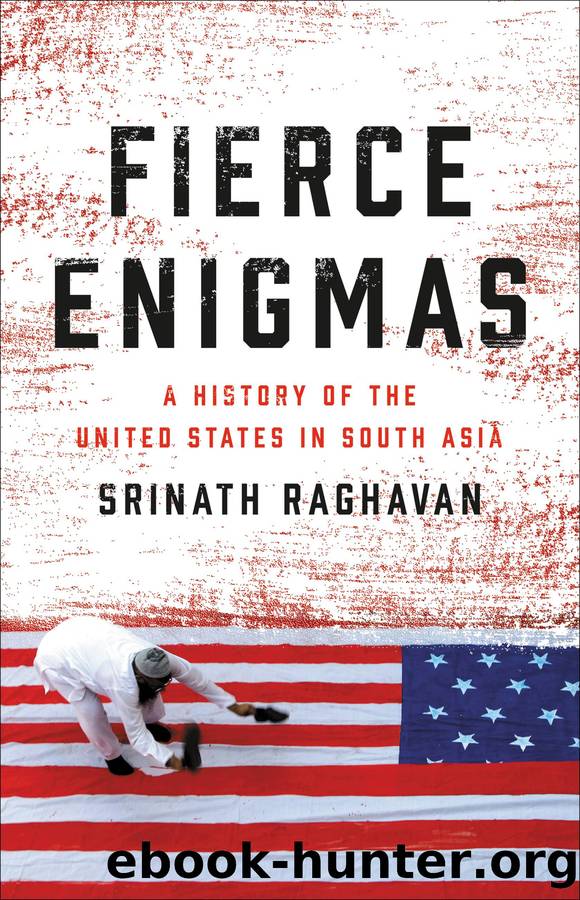
Fierce Enigmas by Srinath Raghavan
Author:Srinath Raghavan [RAGHAVAN, SRINATH]
Language: eng
Format: epub
Publisher: Basic Books
Published: 2018-10-16T00:00:00+00:00
WHILE THE DEADLOCK ON Kashmir persisted, the boundary dispute between India and China was coming to a boil. In late 1961, India embarked on a âforward policyâ of planting puny posts all across the frontier to assert its territorial claims and deter the Chinese from making deeper inroads into the contested areas. In turn, China decided to deploy its own troops to encircle Indian positions. Yet the Chinese were alert to the potential costs of a major offensive against Indian positions. Beijing instructed the Peopleâs Liberation Army (PLA) to avoid skirmishes or opening fire without permission from higher headquarters. While China had considerable military superiority over India, Mao Zedong thought that the PLA could not âblindlyâ take on the Indian forces: âWe must pay attention to the situation.â The Chinese were already feeling âseverely threatened on their southern borderâ by American involvement in Laos and Vietnam, concerns enhanced by the Kennedy administrationâs May 1962 decision to deploy US troops in Thailand. Chinese leaders also worried about their southeast coast. They believed that Chiang Kai-shek would try to take advantage of the mainlandâs economic problems and launch a military attack along with the United States.39 So, Mao was cautious of using force against India.
Nevertheless, from May 1962 Chinese troops began periodically threatening Indian posts, though they always backed off without launching an attack. As tensions soared, the two sides sought to negotiate on the sidelines of the Geneva conference on Laos in which both India and China were participants. The breakdown of these talks led the Chinese to reconsider their options vis-Ã -vis India. By this time, Beijing had good reason to believe that a war against India would not draw in other powers. The Geneva agreement on the neutralization of Laos precluded a US-led or -backed attack on China via that country. This increased the possibility that a Sino-Indian war would remain a limited affair. More importantly, the United States had assured Beijing that it would not support an invasion of the mainland by Chiang Kai-shek.40
Since early 1962 Chiang had been contemplating major military action against the mainland, encouraged both by the acute economic crisis there and by the Sino-Soviet estrangement. In June he told the Americans that he had âa military machine capable of exploiting the deterioration of Communist control on the Mainland.â41 The Kennedy administration, however, felt that these arguments mirrored the debates preceding the Bay of Pigs fiasco and was loath to support any such misadventure by Chiang. Large-scale troop movements by the Chinese complicated the situation across the Taiwan Strait. To restrain both sides, Washington assured Beijing, via the Soviets and the British, that it would not support an attack on the mainland. Meanwhile, Zhou Enlai directed the Chinese ambassador in Warsaw, Wang Bingnan, to meet his US counterpart and probe Americaâs stance.42 On June 23, Wang met John Cabot and expressed Beijingâs concerns about the US military buildup in South Vietnam and Thailand and, most importantly, about the Kuomintangâs preparations for an invasion. Cabot emphatically stated
Download
This site does not store any files on its server. We only index and link to content provided by other sites. Please contact the content providers to delete copyright contents if any and email us, we'll remove relevant links or contents immediately.
| Anthropology | Archaeology |
| Philosophy | Politics & Government |
| Social Sciences | Sociology |
| Women's Studies |
The Secret History by Donna Tartt(19088)
The Social Justice Warrior Handbook by Lisa De Pasquale(12190)
Thirteen Reasons Why by Jay Asher(8910)
This Is How You Lose Her by Junot Diaz(6887)
Weapons of Math Destruction by Cathy O'Neil(6280)
Zero to One by Peter Thiel(5802)
Beartown by Fredrik Backman(5754)
The Myth of the Strong Leader by Archie Brown(5507)
The Fire Next Time by James Baldwin(5446)
How Democracies Die by Steven Levitsky & Daniel Ziblatt(5219)
Promise Me, Dad by Joe Biden(5153)
Stone's Rules by Roger Stone(5088)
A Higher Loyalty: Truth, Lies, and Leadership by James Comey(4964)
100 Deadly Skills by Clint Emerson(4925)
Rise and Kill First by Ronen Bergman(4789)
Secrecy World by Jake Bernstein(4753)
The David Icke Guide to the Global Conspiracy (and how to end it) by David Icke(4720)
The Farm by Tom Rob Smith(4513)
The Doomsday Machine by Daniel Ellsberg(4490)
